
Deluge system testing in Kettering
Deluge system testing with a full trip: the valve opened, water at every nozzle and the spray pattern checked. Watch one of our annual tests below.
-
The deluge valve has been tripped. The pipework downstream is dry, so the clock runs while it fills.
-
Water reaches the open nozzles over the tanks. That delay is timed and compared with the commissioning record.
-
Every nozzle in the zone is open at once, which is what makes it a deluge: the whole hazard is wetted together.
-
We watch each nozzle for a full spray and even coverage of the tanks. A blocked or misaimed nozzle shows up here and nowhere else.
- ISO 9001, the certification insurers look for
- Free survey, fixed price in writing, no travel charge
- Office Monday to Friday, 7am to 5pm; emergency line any hour
Deluge system testing proves the one thing a deluge system is there to do: open its valve and put water on the hazard through every nozzle at once. The film on this page is an annual trip test Sentry Sprinkler Protection carried out on a deluge system protecting bulk storage tanks, from the valve opening to full discharge over the tanks. Sentry Sprinkler Protection does this work across England from its base in Kettering, ISO 9001 certified.
Why a deluge system has to be tripped to be tested
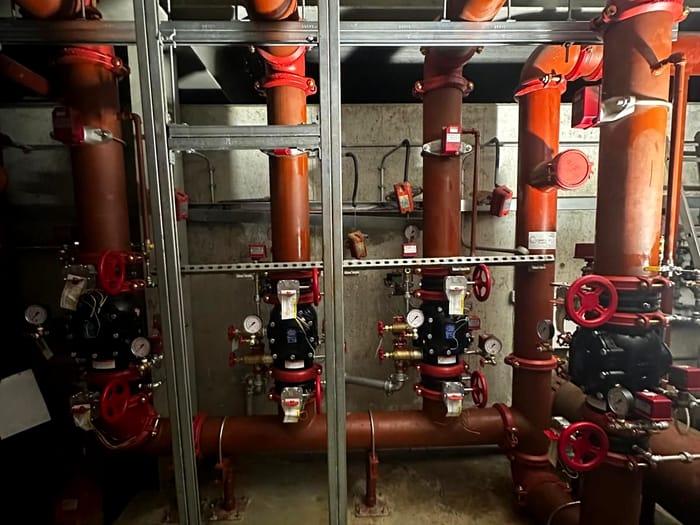
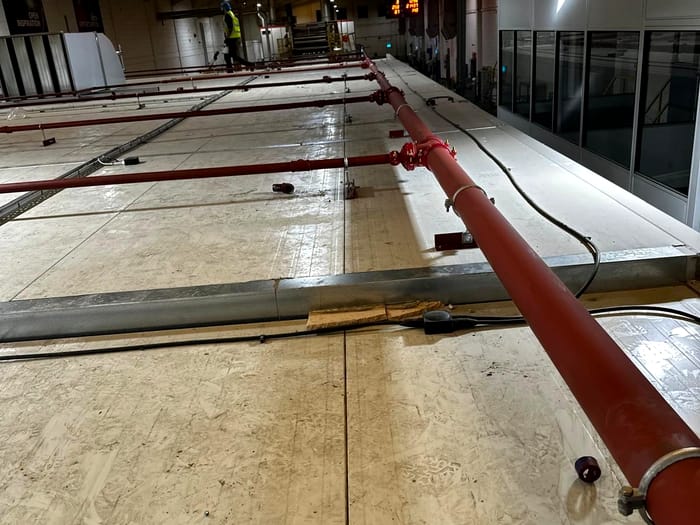
A deluge system has open nozzles and dry pipework. Nothing happens until the deluge valve opens, on a signal from the detection or by its manual release, and then every nozzle in the zone discharges together. It is used where a fire would spread faster than sprinklers could open one by one, such as bulk storage tanks.
Because the pipework stands empty, a gauge reading tells you very little. The only way to know that water will arrive, in time and at every nozzle, is to trip the valve and watch it happen.
What the annual trip test covers
- Agreeing the test with you first: the discharge area, drainage, anything to protect or move, and who needs to know, including your insurer and any alarm receiving centre.
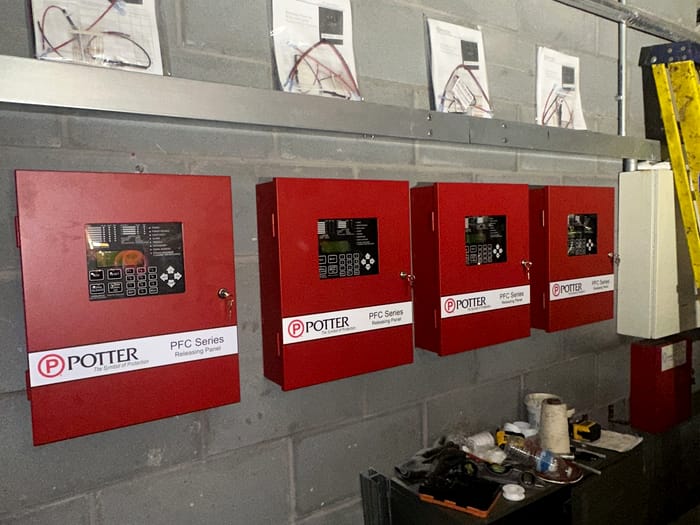
- Tripping the deluge valve on its release, and timing the water from the valve opening to the nozzles against the commissioning record.
- Watching every nozzle discharge: a full spray, the right direction and even coverage of the hazard.
- Reading the pressure at the valve and at the most remote point, and comparing it with the design.
- After the trip: flushing the strainers until they run clear and checking a sample of nozzles for debris, as FM Global Data Sheet 2-81 asks after every trip.
- Resetting the valve, draining down and putting the system back in service before we leave.
How often, under FM Global and NFPA 25
Deluge systems sit outside BS EN 12845, which says in so many words that they are not covered by that standard. The schedule therefore comes from the insurer’s standard the system was designed to.
FM Global Data Sheet 2-81 asks for a partial-flow trip test of the deluge valve every year and a full-flow trip test every three years, the control panel, detection and backup power that open the valve tested every year, and the strainers taken apart and inspected every three years. NFPA 25 asks for a full-flow trip test every year.
Where the hazard and the drainage allow it, a full discharge is the clearest evidence there is, because it is the only test that shows every nozzle working.
What you are left with
A written record of the test: when the valve opened, how long the water took, the pressures, every nozzle that was checked and anything that was not right, each defect priced separately so you can approve it on its own.
That record is what an FM Global surveyor or your fire risk assessor asks to see, and it sits alongside the routine sprinkler servicing of the rest of the site. To see where deluge fits among the other system types, read wet, dry, pre-action and deluge explained.
- 4years of active trading
- 100+ projects completed
- 5.0on Google from 4 reviews
- Freesurvey then a fixed price in writing
Sprinkler servicing, on our jobs
10 photographs of this exact work, from the owner's own sites. Tap any of them.
- SurveyFree, and we walk the building
- Fixed priceIn writing, with the standard named
- First visitDone, recorded and certificated
Related
- Fire sprinkler inspection A written verdict on an existing system, with every defect photographed and priced.
- Fire sprinkler servicing The full BS EN 12845 routine, from the weekly gauge and alarm check to the annual service.
- Types of fire sprinkler system
- Fire sprinkler inspection
- Services Every page in this list, grouped by job.
From first call to certificate
Four steps, the same on every job.
-
 01
Free survey
We look at the building and its records, and tell you what it is due.
-
 02
Fixed price in writing
Every item priced line by line. No survey fee, nothing added afterwards.
-
 03
The work, on your dates
Isolation agreed before anyone arrives, kept as short as the job takes.
-
 04
Certificate and record
A certificate and a photographed defect list, ready for your insurer.
- Start
Book the free survey
Tell us the building. We will tell you what it is due.
Book a free survey
What you have in your hands when we leave
A service visit is finished when the record is, not when the van leaves. This is what stays with you.
-
The written report
With you the same week: what was tested, what it did and what we found.
-
The defect list
Each defect photographed and priced item by item, so you can decide what to fix.
-
The certificate
Issued with the service, for your insurer and your fire risk assessment.
-
The weekly log
A one-page sheet for the checks your own team does between our visits.
Switching from another contractor?
It happens often, and mid-year too. You do not have to wait for the old contract to run out to find out where your sprinkler system stands.
-
Send what you have
The last service report, the certificate, or a photo of the valve set. Whatever you have is enough to start.
-
We survey before we quote
What is installed, the standard it was designed to, whether the pumps make their duty and what the last reports found. Free, and written down.
-
A clean record from our first visit
If the old records are thin we say so and start a clean record, rather than sign off work we did not see.
When is your next visit due?
Pick the system and the month a contractor last came. You will see each routine, the date it falls due and anything that is already late.
Weekly checks are your own team's, logged on site. Our free weekly test log covers them on one page.
1 · The system
2 · The last contractor visit
Pick a month and a year to see your dates.
- Every 3 months Quarterly test Water moving through the system proved to raise the alarm
- Every 6 months Half-yearly service The interim contractor service
- Every 12 months Annual service The full service, with the pump proved under flow
- BS EN 12845
- Every 3 months Quarterly visit The pump checked as part of the sprinkler visit
- Every 12 months Annual performance test Rated flow at rated pressure, not just a start
- BS EN 12845
- Every 6 months Six-monthly inspection Inlets, landing valves, cabinets, caps and access
- Every 12 months Annual pressure test Charged to 12 bar and held for 15 minutes
- BS 9990
- Every 6 months Six-monthly inspection Landing valves, pump set and break tank
- Every 12 months Annual test Pressure test, the pump proved under flow
- BS 9990
Counted from the visit you picked. If that was not the annual service, the annual may fall sooner. Your insurer or fire strategy can ask for more.
Free survey · fixed price in writing
Tell us what you need. We will tell you what it takes.
Four quick taps and your details. A free survey and a fixed price in writing, with no survey fee and no obligation.
Mon to Fri, 7am to 5pm. Emergencies any hour.
Request received
We’ve got it from here.
Step 1 of 5 is done. Here is how the rest goes.
- Request sent Done
- 2 We call you Next
- 3 Free survey
- 4 Fixed price
- 5 Work done
5.0 on Google
4 reviews, and every one of them five stars.
-
Lewis W. Sprinkler installation, warehouse Had them install a full sprinkler system across one of our warehouses, and couldn't be happier. They were professional from start to finish and the on-site team were genuinely friendly to work with. […] Highly recommend if you would need your building or warehouse properly fire-protected.
5 stars on Google
-
Mike C. Weekly maintenance, testing and repair Sentry Sprinkler Protection have recently taken over the weekly maintenance, testing and repair of the […] sprinkler equipment. They are providing a excellent service, good value and they are also very helpful when on site.
5 stars on Google
-
Sam E. Sprinkler pipework installation Couldn't recommend [Sentry] enough. Their work ethic, consistent efficient install of the pipework and overall approach to a project should be something every sub-contractor strives to mirror. Marius is incredibly approachable and methodical in his work with laydown areas kept very neat and tidy and all work carried out in a safe manner.
5 stars on Google
Questions about deluge system testing
Will a deluge trip test flood the site?
Water goes wherever the nozzles point, for as long as the test runs, so it is planned: the discharge area cleared, the drainage checked and anything sensitive protected or moved. Where a full discharge is not practical that year, the valve can be partial-flow trip tested instead, which FM Global Data Sheet 2-81 asks for annually.
How long does a deluge system trip test take?
The discharge itself lasts minutes. Most of the visit is the preparation, the checks after the trip, flushing the strainers and resetting the valve. We tell you how long your system will take, and the fixed price, after the free survey.
Is a deluge system the same as a sprinkler system?
It is a type of sprinkler system, but the heads are open nozzles with no heat element, and the pipework is dry until the deluge valve opens. That is why it is tested by tripping the valve rather than by the routine checks used on a wet system.
What happens when you ring
You talk to Marius Bucur, who runs the company and prices the work. Not a call centre.
07927 555475Mon to Fri, 7am to 5pm. Emergencies any hour.
-
A few plain questions
Usually four: what the building is, what system it has, when it was last serviced and the postcode. If you do not know some of it, that is normal.
-
A straight answer
Whether it is a job for us. If a building would be better served by someone closer, we will tell you that too.
-
A free survey, on your dates
Then a fixed price in writing, line by line. No survey fee, no obligation, nothing added afterwards.