
Fire sprinkler questions, answered
The questions people type into Google about fire sprinklers, answered by Sentry Sprinkler Protection in a few lines each, then properly underneath. Every answer is checked against BS EN 12845 and the LPC Rules, the standards a sprinkler system in the UK is judged by.
- 1Real questions. Each one is typed into Google by people looking after buildings, taken from Search Console and Google's own suggestions.
- 2Answered once. A question gets a page here only if nowhere else on this site already answers it.
- 3Checked against the rules. Every figure is traced to a clause of BS EN 12845 or the LPC Rules, and the clause is named.
Nothing here matches that yet. Ask us on WhatsApp or ring 07927 555475: questions we get asked end up on this page.
Sprinklers
-
Do fire sprinklers detect smoke or heat?
Fire sprinklers detect heat, not smoke. Each head has its own glass bulb or fusible link that breaks at a set temperature, usually 68 °C, and only the heads heated that far open. Smoke, steam or burnt toast cannot set one off, says Sentry Sprinkler Protection, which services these systems across England.
Read the full answer -
How long do fire sprinkler heads last?
A fire sprinkler head has no fixed expiry date under the UK rules: it stays in service for as long as it passes inspection, which is often decades. Sentry Sprinkler Protection replaces heads that are painted, corroded, damaged or have operated, and samples them for testing once a system reaches 25 years.
Read the full answer -
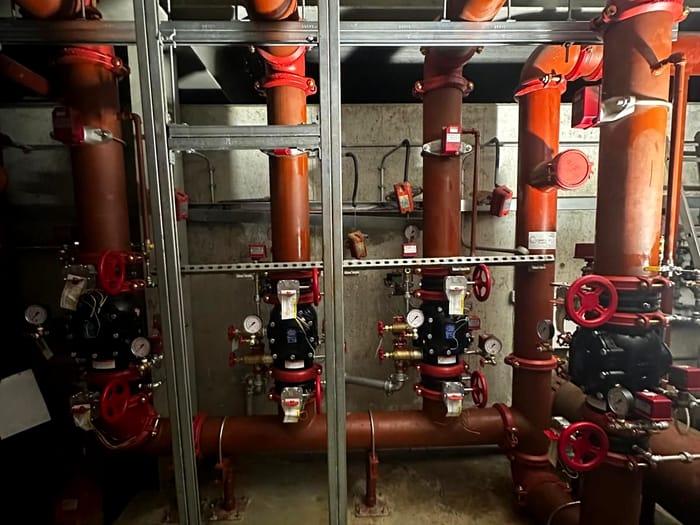
How does a sprinkler alarm valve work?
A sprinkler alarm valve is a one-way valve at the base of the riser. When a head opens, water flows up through it, the valve's clapper lifts, and that opens a port that sends water to the alarm gong on the outside wall and trips a pressure switch to the fire alarm, explains Sentry Sprinkler Protection.
Read the full answer -
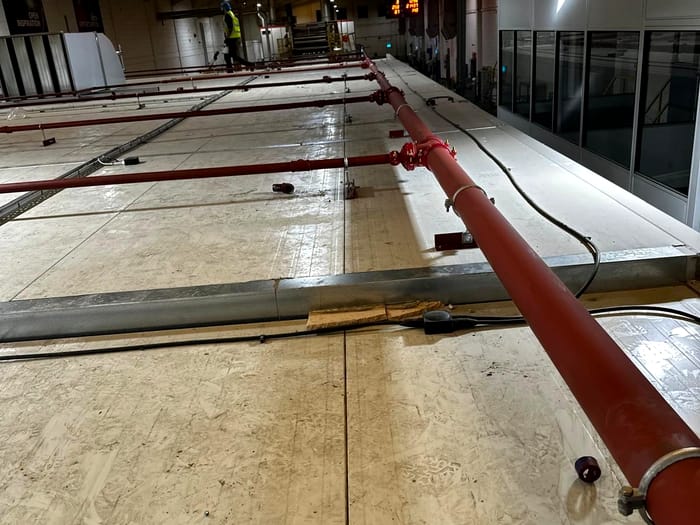
How far apart do fire sprinklers need to be?
Under BS EN 12845, ceiling sprinklers in the UK can be up to 4.6 m apart in a light hazard building, 4.0 m in ordinary hazard and 3.7 m in high hazard, and never closer than 2 m. Each head covers at most 21, 12 or 9 square metres, explains Sentry Sprinkler Protection.
Read the full answer
Fire pumps
Want the whole picture?
The guides go further: 18 longer articles on servicing intervals, what insurers ask for, fire pumps and risers. Company questions, such as how a survey works, are on the FAQ page.
Tell us the building. We will tell you what it is due.
No survey fee to find out where you stand. Describe the site and we will tell you which intervals apply and what the visit involves.
Request received
We’ve got it from here.
Step 1 of 5 is done. Here is how the rest goes.
- Request sent Done
- 2 We call you Next
- 3 Free survey
- 4 Fixed price
- 5 Work done