
Sprinklers
How far apart do fire sprinklers need to be?
Under BS EN 12845, ceiling sprinklers in the UK can be up to 4.6 m apart in a light hazard building, 4.0 m in ordinary hazard and 3.7 m in high hazard, and never closer than 2 m. Each head covers at most 21, 12 or 9 square metres, explains Sentry Sprinkler Protection.
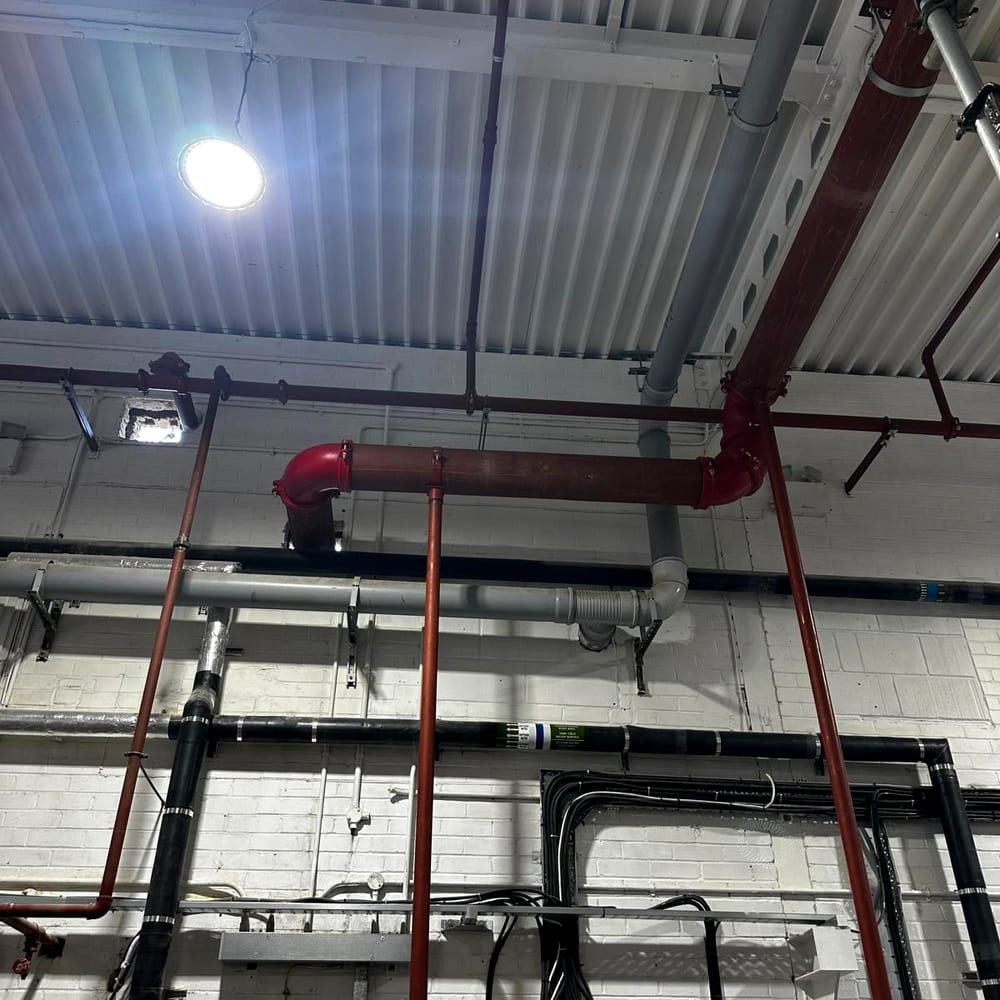
Fire sprinklers in the UK can be up to 4.6 m apart, but how far depends on what the building is used for. BS EN 12845, the standard commercial systems are designed to, sorts every space into a hazard class, and each class has its own maximum spacing and maximum area per head. The rules also set a minimum distance between heads and limits from walls and ceilings. Sentry Sprinkler Protection checks this layout on every survey, because a change of use inside a building can leave the heads too far apart for what is now stored beneath them.
The spacing table
For ordinary ceiling sprinklers (everything except sidewall heads), BS EN 12845 Table 19 sets:
| Hazard class | Typical buildings | Max area per head | Max distance apart |
|---|---|---|---|
| Light hazard (LH) | Low fire load areas split into rooms of no more than 126 m², such as some offices and schools | 21 m² (about 226 sq ft) | 4.6 m |
| Ordinary hazard (OH) | Most commercial buildings: offices, hotels, hospitals, schools, car parks, shops and shopping centres, most factories | 12 m² (about 129 sq ft) | 4.0 m, or 4.6 m along a staggered line |
| High hazard (HHP and HHS) | High hazard processes and storage | 9 m² (about 97 sq ft) | 3.7 m |
The distances are measured between heads along a range pipe and between the range pipes themselves, and both limits apply at once. Heads 4.0 m apart in both directions cover 16 m², which is inside the light hazard limit but outside the ordinary hazard one, so an ordinary hazard layout has to bring the lines closer together.
“Per square foot” is how the question is usually typed, and the answer is the other way round: it is not so many heads per square foot, it is one head per so many square feet, between about 97 and 226 depending on the hazard class.
The minimum: 2 metres
Heads must not be closer than 2 m (clause 12.3). A head that is too close to its neighbour gets wet when the neighbour opens, the spray cools its bulb, and it may then fail to open when the fire reaches it. The standard allows closer spacing only where baffles or the building’s structure stop one head wetting the next, for intermediate heads inside storage racks, and around escalators and stairwells.
Distance from walls
The furthest a head can be from a wall or partition is the smallest of these (clause 12.4.1):
- 2.0 m for a standard layout, or 2.3 m for a staggered one;
- 1.5 m where the roof has open joists or exposed rafters;
- 1.5 m from the open face of an open-sided building;
- 1.5 m beside external walls that are combustible, or made of metal;
- half the maximum spacing in the table for that hazard class.
Walls matter because a fire against a wall is a fire at the edge of the pattern, where fewer heads can reach it.
Distance below the ceiling
Heat rises and spreads under the ceiling first, so heads have to be close to it. Where possible the deflector sits 75 mm to 150 mm below the ceiling or roof, and never more than 0.3 m below a combustible ceiling or 0.45 m below a non-combustible one (clause 12.4.2). Beams, ducts and lights that interrupt the spray have their own rules on top of these.
Sidewall heads
Sidewall sprinklers, which throw water out from the wall rather than down from the ceiling, are spaced by Table 20: up to 4.6 m apart and 17 m² each in light hazard, and 3.4 m apart and 9 m² each in ordinary hazard (3.7 m where the ceiling has at least 120 minutes’ fire resistance). They are mostly used in corridors and small rooms.
Warehouses, racks and special heads
Storage changes everything. High-piled goods, in-rack sprinklers and ESFR heads have their own spacing rules, set by storage height and commodity rather than by this table, and the LPC Rules allow certain extended coverage heads to be spaced further apart than Table 19 where the manufacturer’s data supports it (TB222). Our guide to sprinklers in warehouses covers those cases.
Why heads per pipe size is the wrong question
You will find tables online that say how many heads a 25 mm or 32 mm pipe can feed. Those are pipe schedules from older pre-calculated designs. A system to BS EN 12845 is sized by hydraulic calculation: the pipe has to deliver the design density over the assumed area of operation for that hazard class, from the actual water supply. Two buildings with the same number of heads can need different pipe sizes. Our BS EN 12845 guide explains hazard classes and design density.
Checking your own layout
If a building has changed use, been refitted with new ceilings or partitions, or now stores goods higher than it used to, the spacing that was right when the system was installed may not be right now. A sprinkler service includes a review of the hazard against the installation, and where heads have to be added or moved, our sprinkler installation team designs the change to BS EN 12845.
This work, on our sites
Questions we get asked
Can fire sprinklers be closer than 2 metres apart?
Only in three cases BS EN 12845 allows: where baffles or the building structure stop one head wetting the next, for intermediate heads inside storage racks, and around escalators and stairwells. Otherwise the 2 m minimum stands, because a head that is soaked by its neighbour cools down and may not open when the fire reaches it.
How far from a wall can a sprinkler head be?
No more than 2.0 m with a standard layout, or 2.3 m with a staggered one, and no more than 1.5 m where the roof has open joists or exposed rafters, at the open face of an open-sided building, or beside external walls that are combustible or made of metal. In every case it must also be no more than half the maximum spacing for the hazard class.
How far below the ceiling should a sprinkler be?
Where possible, BS EN 12845 places the deflector between 75 mm and 150 mm below the ceiling or roof, except for ceiling, flush and recessed patterns. It must never be more than 0.3 m below a combustible ceiling or 0.45 m below a non-combustible one, because heat collects at the ceiling and a head too far below it opens late.
Where this comes from
- BS EN 12845Fixed firefighting systems. Automatic sprinkler systems. Design, installation and maintenance
The standard commercial and industrial sprinkler systems are designed, installed and maintained to. It sets the weekly, monthly, quarterly and annual routines.
BSI
- LPC RulesLPC Rules for Automatic Sprinkler Installations, incorporating BS EN 12845
The insurer-facing ruleset that sits alongside BS EN 12845. Part 1 is the standard itself; the technical bulletins in Part 2 are what an insurer means by property protection.
Fire Protection Association
British Standards are copyright documents and most are bought rather than read free. We hold the ones we work to. If you need to know what one of them says about your building, ask us rather than buying it.
Read on
- BS EN 12845, in plain English BS EN 12845 is the European standard for the design, installation and maintenance of fixed fire sprinkler systems in commercial and industrial buildings. It is the document that sets the weekly, monthly, quarterly, half-yearly and annual routines a UK sprinkler system has to be kept to.
- Sprinklers in warehouses: why racking changes everything A warehouse sprinkler system is designed against a specific storage height, storage arrangement and commodity class. Raising the racking, changing what is stored or adding racking under a roof-only design can leave the system unable to control a fire it was never designed for.
- Do fire sprinklers detect smoke or heat? Fire sprinklers detect heat, not smoke. Each head has its own glass bulb or fusible link that breaks at a set temperature, usually 68 °C, and only the heads heated that far open. Smoke, steam or burnt toast cannot set one off, says Sentry Sprinkler Protection, which services these systems across England.
- How long do fire sprinkler heads last? A fire sprinkler head has no fixed expiry date under the UK rules: it stays in service for as long as it passes inspection, which is often decades. Sentry Sprinkler Protection replaces heads that are painted, corroded, damaged or have operated, and samples them for testing once a system reaches 25 years.
- How does a sprinkler alarm valve work? A sprinkler alarm valve is a one-way valve at the base of the riser. When a head opens, water flows up through it, the valve's clapper lifts, and that opens a port that sends water to the alarm gong on the outside wall and trips a pressure switch to the fire alarm, explains Sentry Sprinkler Protection.