
Sprinklers
How does a sprinkler alarm valve work?
A sprinkler alarm valve is a one-way valve at the base of the riser. When a head opens, water flows up through it, the valve's clapper lifts, and that opens a port that sends water to the alarm gong on the outside wall and trips a pressure switch to the fire alarm, explains Sentry Sprinkler Protection.
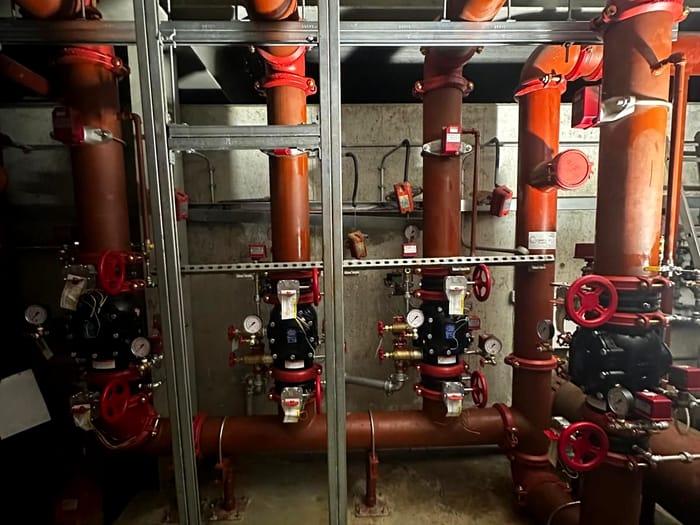
A sprinkler alarm valve is a one-way valve that sits at the base of the riser, where the water supply enters a sprinkler installation. It does two jobs at once. It lets water flow up to the sprinklers but never back down, and the moment water starts flowing to an open head it raises the alarm, without any electricity being needed for the alarm itself. Sentry Sprinkler Protection services and repairs alarm valves on every kind of installation, and this answer explains how one works.
The one-line definition
BS EN 12845, the standard commercial sprinkler systems in the UK are built to, defines an alarm valve as a non-return valve that also starts the water motor fire alarm when the installation operates (clause 3.4). Every installation has one, as part of its control valve set (clause 15.1). The sprinkler riser guide shows where it sits among the stop valve, gauges and drain.
How a wet alarm valve works, step by step
Most buildings have wet installations: the pipework above the valve is full of water all the time.
- At rest. Inside the valve is a hinged disc, the clapper, sitting on a seat. The water pressure above the clapper is the same as, or slightly higher than, the supply pressure below it, so the clapper stays shut. The B gauge below and the C gauge above show those two pressures.
- A head opens. Water starts to spray from the head, and the pressure above the clapper drops below the supply pressure.
- The clapper lifts. The supply pushes the clapper up off its seat and water flows up the riser to the open head.
- The alarm port opens. Lifting the clapper uncovers a small groove or port in the seat. Water now flows through it into the alarm line as well as up to the sprinklers.
- The alarm sounds. That water drives the alarm devices described below, and keeps driving them for as long as water is flowing.
Because the clapper only lifts when water is moving, a wet alarm valve also stops water draining back into the supply, which is the non-return half of its job.
The gong on the outside wall
The water that leaves the alarm port runs along a 20 mm pipe to a water motor: a small turbine that spins a hammer against a bell, the gong. BS EN 12845 puts the gong on the outside of an exterior wall, no more than 6 m above the valve connection, with a strainer in front of the motor nozzle (clause 16.1.2). The pipe to it is limited to an equivalent length of 25 m, and has a stop valve and a permanent 3 mm drain orifice so it empties after a test (clause 16.1.3). Each gong is marked with the number of its installation (16.1.1), so somebody outside knows which part of the building has water flowing.
The gong needs no power at all. That is the point: it still rings in a fire that has taken out the electrics.
The pressure switch to the fire alarm
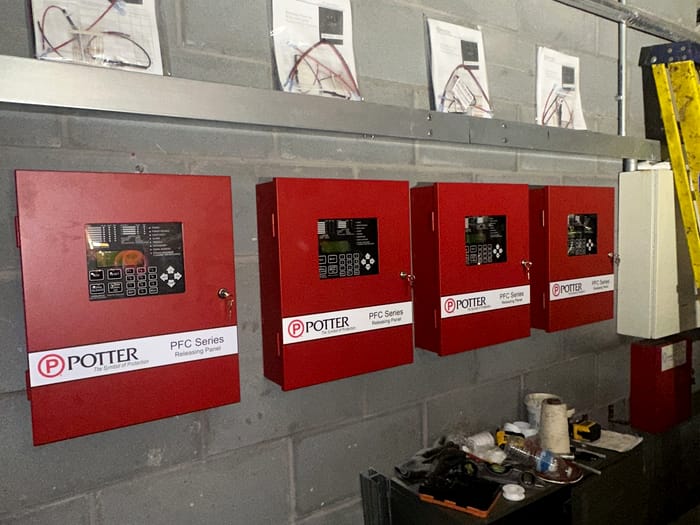
Alongside the gong, every control valve set has an electrical device for a remote alarm (clause 16.1.1): a pressure switch on the alarm line, or a flow switch in the pipework (16.2). It signals the building’s fire alarm panel and, usually, an alarm receiving centre, so the fire service is called even if nobody hears the gong.
Stopping false alarms
A brief surge in the town main can lift a clapper without any head being open. Many wet alarm valves are therefore fitted with a retard chamber, a small vessel in the alarm line that has to fill before enough water reaches the gong and the switch, so a short surge drains away without ringing anything. The LPC Rules say that where surges still cause false alarms, the insurer should be consulted and the servicing contractor asked to modify the system (TB203).
How a dry alarm valve is different
Where the pipes could freeze, or the space runs hotter than 70 °C, BS EN 12845 calls for a dry installation instead (clause 11.2.1). Its alarm valve holds compressed air in the pipework above the clapper and water below. Because air at a modest pressure can hold back water at a much higher one across a larger clapper area, the valve stays shut until a head opens and the air escapes. When the air pressure has fallen far enough, the valve trips, water rushes into the pipes, and the alarm port works as before. Larger dry installations often have an accelerator that trips the valve sooner. The types of sprinkler system page compares wet, dry, pre-action and deluge.
How it is tested
The alarm is proved every week without opening a sprinkler. The alarm test valve at the control valve set lets water into the alarm line, and BS EN 12845 requires each water motor alarm to sound for at least 30 seconds (clause 20.2.2.3). The result is written in the log book.
When an alarm valve goes wrong
Three faults matter most: a clapper that no longer seals, so the valve passes water and the jockey pump keeps running; a blocked strainer or seized water motor, so the gong does not ring on test; and a pressure switch that no longer trips the panel. All three leave a building with a system that looks normal and will not raise the alarm properly. If your gong is silent on the weekly test or rings on its own, our sprinkler alarm valve repair page explains what we do, and a routine sprinkler service checks the valve, the gong and the switch at every visit.
This work, on our sites
Questions we get asked
Why does the sprinkler gong ring when there is no fire?
The usual causes are a leak or a damaged head letting water move through the valve, or a pressure surge in the town main lifting the clapper for a moment. The LPC Rules treat leaks and damaged heads as needing repair straight away, and say a contractor should modify the system, with the insurer consulted, if surges in the main keep ringing it.
How often should the sprinkler alarm be tested?
Every week. BS EN 12845 requires each water motor alarm to be sounded for at least 30 seconds as part of the weekly routine, using the alarm test valve at the control valve set, so no sprinkler has to be opened. The result goes in the system log book.
What is the difference between a wet and a dry alarm valve?
A wet alarm valve has water on both sides of the clapper all the time. A dry alarm valve holds compressed air in the pipework above it and water below, and is only used where the pipes could freeze or the space runs above 70 °C. When a head opens on a dry system the air escapes first, the valve trips, and water then fills the pipes.
Where this comes from
- BS EN 12845Fixed firefighting systems. Automatic sprinkler systems. Design, installation and maintenance
The standard commercial and industrial sprinkler systems are designed, installed and maintained to. It sets the weekly, monthly, quarterly and annual routines.
BSI
- LPC RulesLPC Rules for Automatic Sprinkler Installations, incorporating BS EN 12845
The insurer-facing ruleset that sits alongside BS EN 12845. Part 1 is the standard itself; the technical bulletins in Part 2 are what an insurer means by property protection.
Fire Protection Association
British Standards are copyright documents and most are bought rather than read free. We hold the ones we work to. If you need to know what one of them says about your building, ask us rather than buying it.
Read on
- What is a sprinkler riser? A sprinkler riser is the vertical pipe that carries water up from the control valve set to the sprinkler pipework above, and in everyday use the name covers the whole assembly at its base: stop valve, alarm valve, gauges, and test and drain valves.
- How a fire sprinkler system actually works Each sprinkler head is held shut by a heat-sensitive glass bulb or fusible link, so only the heads directly over a fire open. The resulting flow drops the pressure in the pipework, which starts the pump and operates the alarm.
- Do fire sprinklers detect smoke or heat? Fire sprinklers detect heat, not smoke. Each head has its own glass bulb or fusible link that breaks at a set temperature, usually 68 °C, and only the heads heated that far open. Smoke, steam or burnt toast cannot set one off, says Sentry Sprinkler Protection, which services these systems across England.
- How long do fire sprinkler heads last? A fire sprinkler head has no fixed expiry date under the UK rules: it stays in service for as long as it passes inspection, which is often decades. Sentry Sprinkler Protection replaces heads that are painted, corroded, damaged or have operated, and samples them for testing once a system reaches 25 years.
- How far apart do fire sprinklers need to be? Under BS EN 12845, ceiling sprinklers in the UK can be up to 4.6 m apart in a light hazard building, 4.0 m in ordinary hazard and 3.7 m in high hazard, and never closer than 2 m. Each head covers at most 21, 12 or 9 square metres, explains Sentry Sprinkler Protection.