
Sprinklers
How long do fire sprinkler heads last?
A fire sprinkler head has no fixed expiry date under the UK rules: it stays in service for as long as it passes inspection, which is often decades. Sentry Sprinkler Protection replaces heads that are painted, corroded, damaged or have operated, and samples them for testing once a system reaches 25 years.
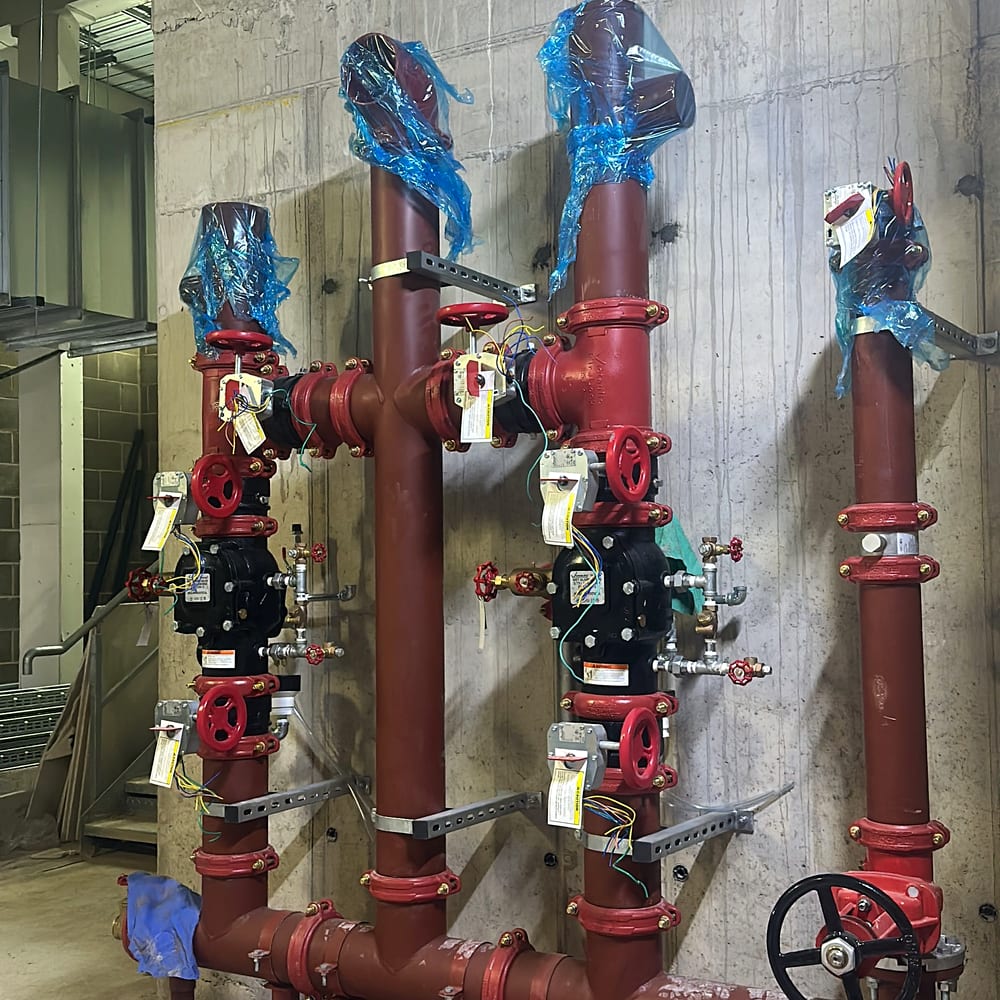
A fire sprinkler head has no fixed lifespan under the UK rules. There is no age at which the heads in a building must all be changed. A head stays in service for as long as it passes inspection, and in a clean, dry, heated building that is commonly several decades. What ends a head’s life is its condition, not its birthday. Sentry Sprinkler Protection inspects heads on every service visit, and this answer sets out when one has to come out and what the rules ask for as a system ages.
Why there is no expiry date
A sprinkler head is a simple, sealed part: a frame, a plug, a seal and a glass bulb or fusible link. Nothing in it wears from use, because in a normal life it is never used. What harms it is its surroundings: corrosion from damp or chemical air, dust and grease that coat it, paint from a redecoration, and knocks from people and machinery.
So BS EN 12845, the British and European standard for commercial sprinkler systems, and the LPC Rules that insurers apply on top of it, do not set a replacement age. They set an inspection regime and say what must be replaced when it is found.
When a head must be replaced
| Finding | What the rules say |
|---|---|
| Painted head | Replaced, not cleaned. Paint slows the bulb or link (BS EN 12845, 20.3.2.3) |
| Distorted or damaged head | Replaced (20.3.2.3) |
| Head covered in dust or deposits | Carefully cleaned; replaced if it cannot be (20.3.2.3) |
| Head that has operated | Replaced with one of the correct type and temperature rating (LPC Rules, TB203) |
| Unopened heads near a fire | Checked for heat damage and replaced as necessary (TB203) |
| Weeping or leaking head | Replaced, never tightened |
Those checks are part of the quarterly routine, so a properly serviced system should never carry a painted or damaged head for long. The servicing intervals guide sets out what happens at each visit, and the sprinkler repairs guide explains why a dripping head is changed rather than tightened.
The 25 year inspection
Age does matter once, at 25 years. BS EN 12845 recommends an inspection of the pipes and the heads at that point (Annex K), and the LPC Rules replace that annex with their own requirement for insured systems (TB203.3.8).
The work involves:
- Flushing the pipework from its remote ends until the water runs clear, and looking inside for debris and for the nodules that bacterial corrosion leaves (TB203.3.8.1).
- Removing sample heads from near the ends of range pipes, where debris settles, and inspecting the head and the pipe it came from.
- Testing the samples. Annex K suggests 20 heads of each type for an installation of up to 5,000 heads, rising to 100 for 40,000, checked for operation, operating temperature, K-factor, lodgement and thermal sensitivity (Table K.1).
If debris of 5 mm or more turns up, or there are blocked heads or persistent pinhole leaks, the debris has to be cleared from every installation that could be affected and the system’s performance proved again (TB203.3.8.1). Heads that come through the inspection in good condition stay in service. On systems with several installations, the LPC Rules then require each one to be re-inspected and flushed at least every ten years.
Dry pendent heads are the exception
One kind of head is sampled much sooner. Dry pendent heads, the ones on a dry drop pipe that protect cold stores and other spaces where water in the pipe would freeze, have representative samples removed and tested at the interval the manufacturer gives, or every five years where it gives none. The sample is 5 % of each batch or twenty heads, whichever is greater (LPC Rules, TB203 five-yearly routine).
The American 50 year rule
You may read that sprinkler heads must be replaced at 50 years. That comes from the American standard NFPA 25, which calls for 50-year-old heads to be replaced or sample tested. It does not apply to UK systems designed to BS EN 12845, which use the inspection and sampling regime above instead.
What you should have on site
BS EN 12845 requires a stock of spare heads, kept with the correct sprinkler spanner in a cabinet in a prominent place where the temperature stays at or below 27 °C (clause 20.1.4):
- at least 6 for a light hazard installation;
- at least 24 for ordinary hazard;
- at least 36 for high hazard;
- plus spares of any special heads in the building, such as high temperature, sidewall or concealed patterns.
The stock is replaced as soon as any are used. An empty spares cabinet is one of the first things an insurer’s surveyor notices.
Getting the heads checked
If you do not know when your heads were last inspected, or your system is approaching 25 years with nobody having mentioned it, a sprinkler service will tell you where it stands. If a head has been damaged or has operated, our emergency call-out line covers making the system safe and replacing it like for like.
This work, on our sites
Questions we get asked
Do sprinkler heads have an expiry date?
Not in BS EN 12845 or the LPC Rules. There is no age at which every head must be changed. What the rules require instead is inspection: heads are looked at every quarter, sampled and tested once the system is 25 years old, and replaced whenever one is found painted, distorted, corroded or damaged.
How many spare sprinkler heads should be kept on site?
BS EN 12845 sets a minimum of 6 for a light hazard installation, 24 for ordinary hazard and 36 for high hazard, plus spares of any special heads such as high temperature or sidewall patterns. They are kept with the correct spanner in a cabinet somewhere easy to reach where the temperature does not exceed 27 °C, and the stock is topped up as soon as any are used.
Can our maintenance team change a sprinkler head?
Changing a head means isolating and draining part of a system that is protecting the building, fitting a head of exactly the right type, rating and K-factor, and recommissioning it afterwards. It should be done by a competent sprinkler engineer and recorded, because the insurer will expect to see who did it and what went back in.
Where this comes from
- BS EN 12845Fixed firefighting systems. Automatic sprinkler systems. Design, installation and maintenance
The standard commercial and industrial sprinkler systems are designed, installed and maintained to. It sets the weekly, monthly, quarterly and annual routines.
BSI
- LPC RulesLPC Rules for Automatic Sprinkler Installations, incorporating BS EN 12845
The insurer-facing ruleset that sits alongside BS EN 12845. Part 1 is the standard itself; the technical bulletins in Part 2 are what an insurer means by property protection.
Fire Protection Association
British Standards are copyright documents and most are bought rather than read free. We hold the ones we work to. If you need to know what one of them says about your building, ask us rather than buying it.
Read on
- How often should sprinklers be serviced? Under BS EN 12845, sprinklers are checked weekly by the site, checked monthly for water and fuel, tested quarterly, given an interim contractor service every six months and a full service once a year, with the pump proved under flow.
- Sprinkler repairs: leaks, seized valves and damaged heads Most sprinkler repairs are corroded pipework, seized or passing valves, impact-damaged heads and failed flow switches, and almost all of them need the affected section isolated, drained, repaired and recommissioned rather than tightened in place.
- Do fire sprinklers detect smoke or heat? Fire sprinklers detect heat, not smoke. Each head has its own glass bulb or fusible link that breaks at a set temperature, usually 68 °C, and only the heads heated that far open. Smoke, steam or burnt toast cannot set one off, says Sentry Sprinkler Protection, which services these systems across England.
- How does a sprinkler alarm valve work? A sprinkler alarm valve is a one-way valve at the base of the riser. When a head opens, water flows up through it, the valve's clapper lifts, and that opens a port that sends water to the alarm gong on the outside wall and trips a pressure switch to the fire alarm, explains Sentry Sprinkler Protection.
- How far apart do fire sprinklers need to be? Under BS EN 12845, ceiling sprinklers in the UK can be up to 4.6 m apart in a light hazard building, 4.0 m in ordinary hazard and 3.7 m in high hazard, and never closer than 2 m. Each head covers at most 21, 12 or 9 square metres, explains Sentry Sprinkler Protection.