
Sprinklers
What is a sprinkler riser?
A sprinkler riser is the vertical pipe that carries water up from the control valve set to the sprinkler pipework above, and in everyday use the name covers the whole assembly at its base: stop valve, alarm valve, gauges, and test and drain valves.
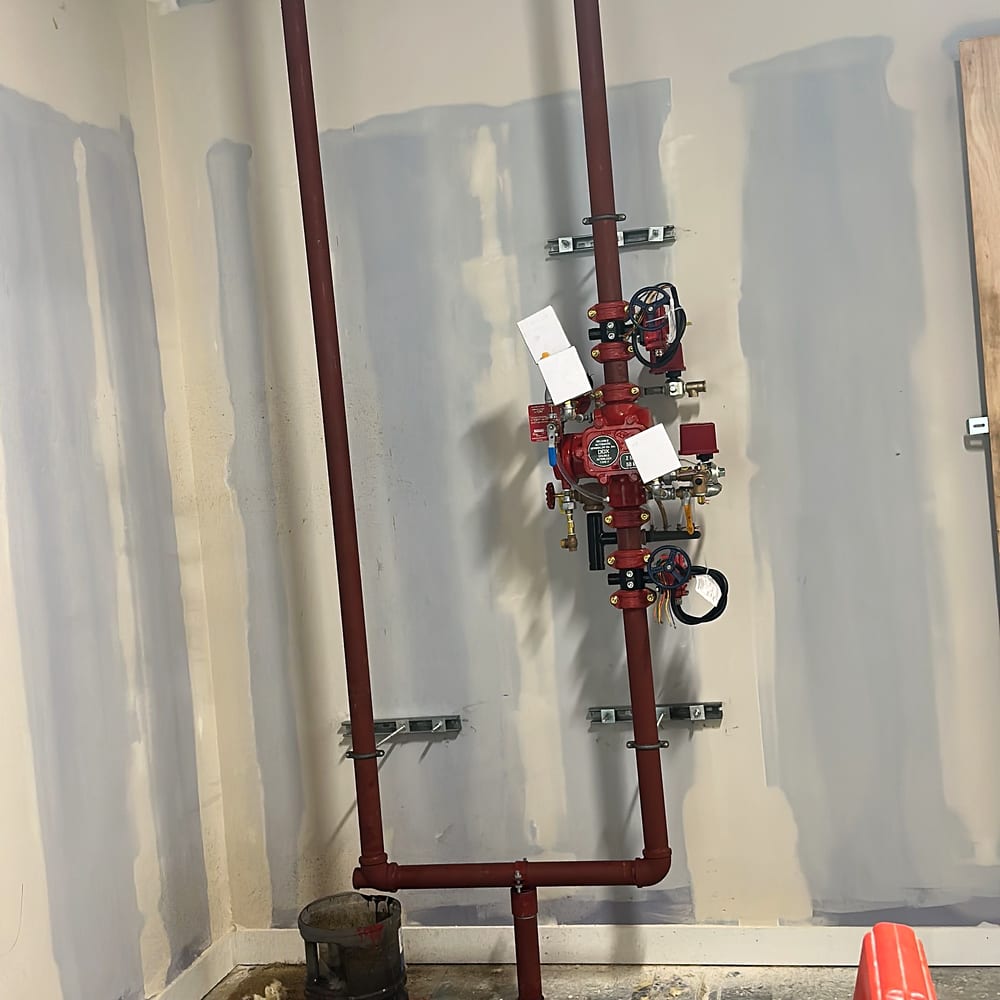
A fire sprinkler riser is the vertical pipe that takes water from the control valve set up to the sprinkler pipework on the floors above. In conversation the word usually means more than the pipe: it means the whole assembly at the bottom of it, the valves, gauges and alarm trim that every sprinkler installation is controlled from. Sentry Sprinkler Protection inspects and services these assemblies on every sprinkler visit, and this guide explains what each part does and what a building owner should expect to see.
The pipe and the assembly
BS EN 12845 defines a riser narrowly, as a vertical distribution pipe feeding a distribution or range pipe above (clause 3.52 in the LPC Rules 2015 book). That is the pipe itself.
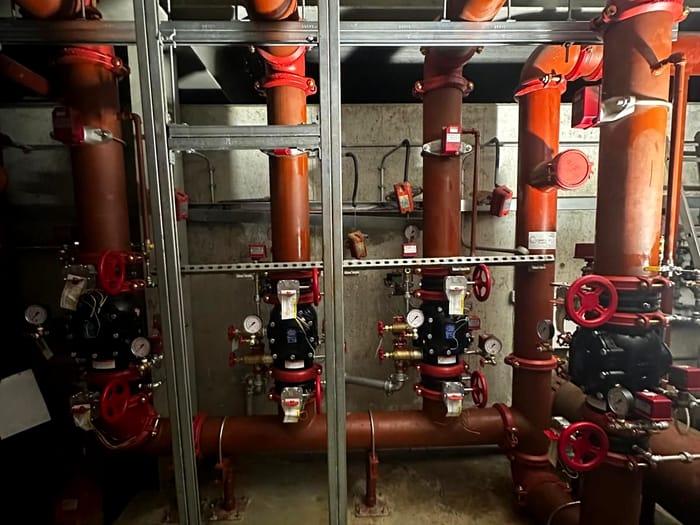
When a facilities manager or an engineer says “the sprinkler riser”, though, they nearly always mean the riser together with its control valve set: the assembly where the water supply enters the installation and from which the riser climbs. Every installation must have one, made to EN 12259-2 for wet systems or EN 12259-3 for dry ones (clause 15.1). It is the heart of the system, because it is where the water is turned on and off and where the alarm is raised when a sprinkler operates.
A riser sprinkler system, then, is simply a sprinkler installation fed through a riser: the supply comes in at the bottom, passes the control valve set, and rises to the pipework serving each floor.
What you will find on a sprinkler riser
Stand in front of one and you will see the same few parts, in roughly this order from the bottom up.
| Part | What it does | Where the rule is |
|---|---|---|
| Main stop valve | Turns the water to the installation on and off. Must close clockwise, show open or shut, and be strapped and padlocked open | BS EN 12845, 15.2 |
| B gauge | Shows the supply pressure, immediately before the control valve set | 15.7.3 a) |
| Alarm valve | Lifts when water flows to an open sprinkler and sends water to the alarm | 15.1 |
| C gauge | Shows the pressure held in the installation, immediately after the valve set | 15.7.3 b) |
| Alarm test valve | A 15 mm valve that lets water through to prove the alarm without opening a sprinkler | 15.5.1 |
| Drain valve | Empties the installation for maintenance, with its outlet no more than 3 m above the floor | 15.4 |
On a dry installation the alarm valve holds air above it rather than water, and its B gauge must also have a pointer that records the highest pressure reached (15.7.3). The types of sprinkler system page explains why some areas are dry.
The alarm itself is raised in one of two ways: water through the valve turns a water motor gong on the outside wall, or it trips a flow or pressure switch wired to the building’s fire alarm. Our guide on how a sprinkler system works follows the water from the sprinkler back to that alarm.
Where the riser is, and why access matters
The riser sits where the supply enters the protected area: a sprinkler valve room, a plant room, or a riser cupboard, usually on the ground floor and usually signed on the door.
Three things about that room matter more than they look:
- It must stay above freezing. The LPC Rules check the valve room temperature every week (TB203.2.3), because a frozen valve set is a system that cannot operate.
- It must stay clear. The fire service and your contractor both need to reach the valves quickly. A riser cupboard that has become a store room slows everyone down.
- It must stay locked to strangers but open to you. Somebody on site should hold the key and know where the room is.
What gets checked, and how often
Under the LPC Rules, which carry the BS EN 12845 routines with the FPA’s technical bulletins, the riser is the first thing looked at on every visit.
Every week (TB203.2.2), the routine includes:
- reading and recording the B and C gauges (TB203.2.2.2 a);
- confirming the stop valves are locked open (TB203.2.2.2 c);
- opening the alarm test valve and checking the alarm bell rings for 30 seconds and any pressure switch operates (TB203.2.2.3).
A free weekly test log sets those out in order, with space for the readings.
At the service visits the valve set is looked at in much more depth, and at the annual service it is stripped and inspected rather than simply tested. That difference matters on a quotation: “inspected” and “stripped” are not the same job. Our sprinkler servicing intervals guide sets out what each visit adds.
The faults we find on risers
Most riser faults are small, and most are found by someone simply looking.
- A valve left shut after maintenance, or half shut, with no strap and padlock. This is the one that matters most, because the system looks normal and will not work.
- Gauge readings drifting from what they were last month. A falling C gauge on a wet system points to a leak; a falling B gauge points to the supply.
- An alarm valve that passes, letting a trickle through that keeps a jockey pump running or the alarm chattering.
- A pressure switch or flow switch that no longer reports, so a sprinkler could operate without the alarm ever telling anyone.
- A dry valve room that gets cold in winter because a heater has failed.
Every one of those is a repair rather than a replacement, and most can usually be put right on the same visit. Where the riser needs alterations because the building has changed, that is a design question; our sprinkler installation team handles extensions and upgrades.
A sprinkler riser is not a dry or wet riser
The names collide, and it causes real confusion on site.
A sprinkler riser feeds the automatic sprinklers and is charged all the time, so the system operates on its own when a sprinkler opens.
A dry riser or wet riser is a firefighting main for the fire service to connect hoses to on each floor, designed to BS 9990. A dry riser is empty until the fire service pumps water into it; a wet riser is kept full by its own pumps. Our guide to wet and dry risers explains the difference between those two.
A building can have both kinds, sometimes in the same shaft, and each has its own test regime.
Residential sprinkler systems
Sprinklers in blocks of flats are designed to BS 9251, a different standard from BS EN 12845, and the valve arrangements differ with it. What this guide says about clauses and weekly checks applies to commercial BS EN 12845 installations. Our guide to sprinklers in blocks of flats covers the residential side.
What to do next
If you are responsible for a building with a sprinkler system, three things are worth doing this week: find the riser, check every valve on it is strapped and padlocked open, and look at the last few weeks of gauge readings. If any of those is harder than it should be, sprinkler servicing from Sentry Sprinkler Protection puts the riser on a routine and records it properly, with a certificate and a photographed defect list after every visit.
This work, on our sites
Questions we get asked
Is a sprinkler riser the same thing as a dry riser?
No. A sprinkler riser feeds the automatic sprinklers and is full of water, or of air on a dry system, all the time, ready to operate on its own. A dry riser is an empty firefighting main that the fire service charges from an inlet outside when they arrive. They are designed to different standards: BS EN 12845 for sprinklers, BS 9990 for dry and wet risers.
Where is the sprinkler riser in a building?
At the point where the water supply enters the protected area: a sprinkler valve room, a plant room, or a riser cupboard on the ground floor. It is usually signed on the door. If nobody on site can find it, that is worth fixing before anything else, because the fire service and your contractor both need to reach it quickly.
What do the two pressure gauges on a sprinkler riser show?
The B gauge sits just before the control valve set and shows the pressure of the water supply. The C gauge sits just after it and shows the pressure held in the installation. Under BS EN 12845 both are read and written down every week, and a change from the usual figures is the first sign of a supply problem or a leak.
Should the main valve on a sprinkler riser be locked?
Yes, locked open. BS EN 12845 requires every stop valve that could cut off the water to the sprinklers to show whether it is open or shut and to be secured with a strap and padlock or equivalent. A shut valve leaves the system looking normal while it cannot deliver water.
Where this comes from
- BS EN 12845Fixed firefighting systems. Automatic sprinkler systems. Design, installation and maintenance
The standard commercial and industrial sprinkler systems are designed, installed and maintained to. It sets the weekly, monthly, quarterly and annual routines.
BSI
- LPC RulesLPC Rules for Automatic Sprinkler Installations, incorporating BS EN 12845
The insurer-facing ruleset that sits alongside BS EN 12845. Part 1 is the standard itself; the technical bulletins in Part 2 are what an insurer means by property protection.
Fire Protection Association
British Standards are copyright documents and most are bought rather than read free. We hold the ones we work to. If you need to know what one of them says about your building, ask us rather than buying it.