
Fire pumps
How many fire pumps does a sprinkler system need?
A sprinkler system fed from a tank by one pump has a single water supply. Where the insurer, a high-rise building or a life safety design needs a more reliable supply, BS EN 12845 calls for two or more pumps, and normally no more than one of them may be electric, explains Sentry Sprinkler Protection.
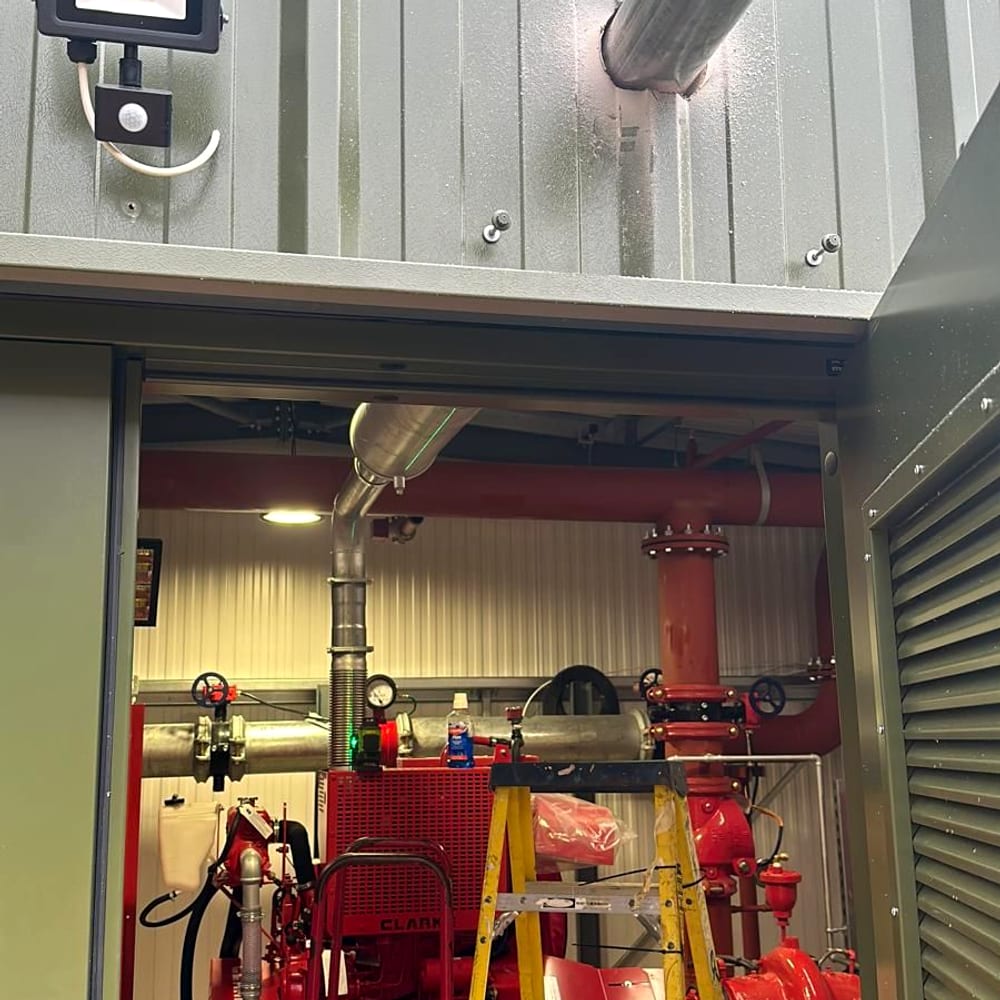
A sprinkler system needs as many fire pumps as its water supply requires, and that is one, two or three. A tank with one pump is an ordinary single supply. A system that has to be more reliable, because the insurer demands it, because the building is high-rise, or because the design protects lives, needs two or more pumps, and BS EN 12845 normally limits how many of those may run on electricity. Sentry Sprinkler Protection services fire pump sets of every size, and this answer sets out how the number is decided.
It starts with the water supply
BS EN 12845, the standard commercial sprinkler systems in the UK are designed to, does not count pumps. It counts water supplies, and the pumps follow from the kind of supply the system needs. There are three grades.
| Water supply | What it can be | Pumps |
|---|---|---|
| Single (9.6.1) | A town main, a town main with booster pumps, a pressure tank (light and ordinary hazard group 1 only), a gravity tank, or a tank or other source with one or more pumps | One is enough |
| Superior single (9.6.2) | A town main fed from both ends, a full capacity storage tank with two or more pumps, or an inexhaustible source such as a river or canal with two or more pumps | Two or more |
| Duplicate (9.6.3) | Two single supplies, each independent of the other, each meeting the full pressure and flow on its own | Depends on the two supplies chosen |
The jump from one pump to two is what turns a tank and pump set from an ordinary single supply into a superior one. That is the most common reason a building has a pair of fire pumps side by side.
Who decides which grade you need
Three things push a system up from a single supply:
- The insurer. The LPC Rules, which most UK property insurers apply, grade systems I, II or III by their water supplies (TB204). A Grade I system needs duplicate supplies, or a superior single supply where the system is small enough; a Grade II system needs at least a superior single supply. Insurers set the grade they want in their requirements for the building.
- High-rise buildings. BS EN 12845 Annex E requires at least one superior single water supply for high-rise systems (E.3.1).
- Life safety. Where the system is designed to protect lives rather than only property, Annex F requires the same (F.6).
A warehouse insured for property protection may therefore have a single tank and pump, while a tower block or a care home of similar size has two pumps or more.
Two pumps or three
Where pumps run in parallel, BS EN 12845 sets how big each must be (clause 10.2):
- Two pumps: each must deliver the full specified flow and pressure on its own.
- Three pumps: each must deliver at least 50 % of the specified flow at the specified pressure.
The aim in both cases is the same: lose any one pump, to a fault or to maintenance, and the system still gets the water it was designed for.
Why the second pump is usually diesel
The same clause adds a rule that decides what the pump room looks like: where more than one pump is installed in a superior or duplicate supply, no more than one may be driven by an electric motor. The LPC Rules apply that limit to high hazard systems, and say that anywhere else two electric pumps need the approval of the insurer, or of the fire authority on a life safety system (TB210.2). In practice a pair of pumps is normally one electric and one diesel.
This is the answer to whether fire pumps need emergency power. The standard does not rely on a generator; it relies on a diesel engine with its own fuel tank and two banks of starter batteries, which keeps running if the building’s electrical supply is lost in the fire. Our guide to fire pumps explains how electric and diesel sets differ, and who decides between them on a single-pump system.
The jockey pump does not count
Most pump rooms also have a small jockey pump. It tops up the pressure in the pipework against small leaks, so the main pump does not start every time the pressure creeps down. It cannot deliver the flow a fire needs and it is not part of the water supply, so it does not count towards the number of pumps.
What more pumps mean for maintenance
Every main pump is tested every week, with a diesel set also restarted after its test, and each must be flow tested so you know it delivers its duty point, not just that it starts. Two or three pumps mean two or three sets of those records. The fire pump testing guide explains what a proper test shows.
If you are not sure what your pump room is meant to provide, or a pump has been out of service and you need to know whether the system is still compliant, our fire pump servicing covers electric, diesel and jockey sets, and the sprinkler tank that feeds them.
This work, on our sites
Questions we get asked
Do fire pumps need a backup generator?
Not usually. Where more than one pump serves a superior or duplicate supply, the rules normally allow only one of them to be electric, so the second is a diesel set that carries its own fuel and batteries. That, rather than a generator, is how the system keeps working if the mains supply fails in a fire.
Is the jockey pump counted as one of the fire pumps?
No. A jockey pump is a small pump that tops up the pressure in the pipework so the main pump does not start for every minor leak. It cannot deliver the flow the sprinklers need in a fire, so it does not count towards the number of pumps the water supply requires.
If we have two pumps, does each one have to be full size?
Yes, where there are two. BS EN 12845 requires each pump in a pair to deliver the full specified flow and pressure on its own, so the system still works with one pump out of action. Where there are three, each must deliver at least half the specified flow at the specified pressure.
Where this comes from
- BS EN 12845Fixed firefighting systems. Automatic sprinkler systems. Design, installation and maintenance
The standard commercial and industrial sprinkler systems are designed, installed and maintained to. It sets the weekly, monthly, quarterly and annual routines.
BSI
- LPC RulesLPC Rules for Automatic Sprinkler Installations, incorporating BS EN 12845
The insurer-facing ruleset that sits alongside BS EN 12845. Part 1 is the standard itself; the technical bulletins in Part 2 are what an insurer means by property protection.
Fire Protection Association
British Standards are copyright documents and most are bought rather than read free. We hold the ones we work to. If you need to know what one of them says about your building, ask us rather than buying it.
Read on
- Fire pumps: electric, diesel, and what the jockey pump is for A fire pump set develops the pressure and flow a sprinkler or wet riser system needs. It normally comprises a main pump driven by an electric motor or a diesel engine, plus a small jockey pump that holds the system at pressure so the main pump does not start on minor leakage.
- Fire pump testing: why starting it is not testing it A start test proves the starter, the battery and the controller. Only a flow test proves the pump delivers its rated flow at its rated pressure, which is the only thing that matters in a fire.